
INSIGHT

- Home
- INSIGHT
- Spare Parts
- Nail Gun Repair Essentials: 5 Spare Parts Worth Stocking
Nail Gun Repair Essentials: 5 Spare Parts Worth Stocking
September 03,2026
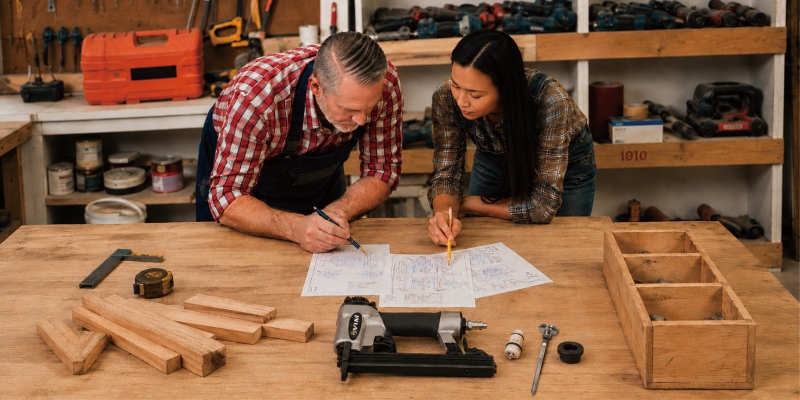
A nail gun can perform thousands of firing cycles during regular use, placing continuous stress on its internal components. Over time, wear, impact, friction, and repeated air pressure can cause individual parts to deteriorate, leading to problems such as air leaks, weak driving power, fastener jams, or inconsistent firing.
For workshops, distributors, and repair centers, many of these problems do not require replacing the entire tool. Having the right nail gun repair parts available can make repairs faster, reduce unnecessary downtime, and help extend the service life of frequently used nail guns.
In this article, we will look at five common spare parts worth considering for workshop inventory: the driver assembly, bumper, O-rings, cylinder cap seal, and trigger valve assembly. We will also explain what each part does, common signs of wear or failure, and what to check when selecting the correct replacement.
Why Keeping Common Nail Gun Repair Parts in Stock Matters
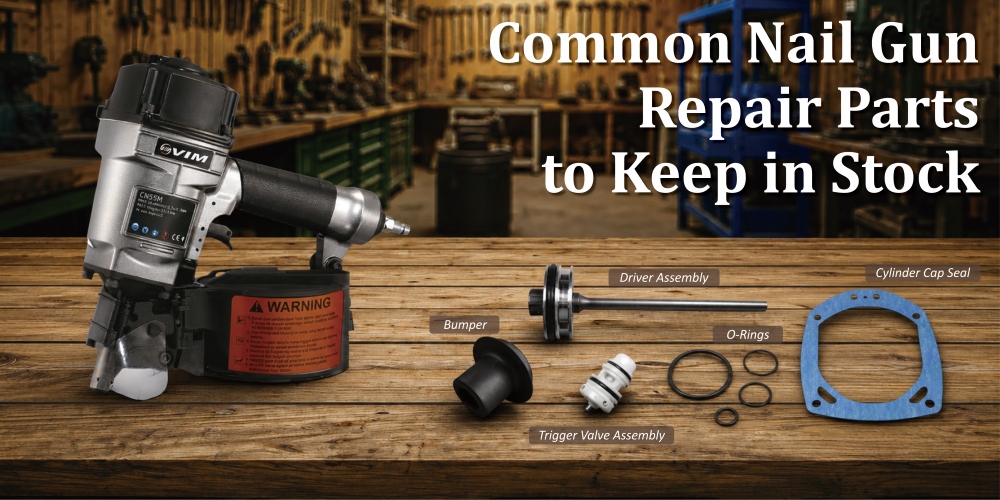
Pneumatic nail guns are built for demanding and repetitive work, but internal components are constantly exposed to impact, friction, and compressed air. Over time, these parts naturally wear and may eventually need to be replaced.
In many cases, a nail gun stops working because of a single worn or damaged spare part, rather than a failure of the entire tool. For workshops and maintenance teams, keeping commonly used nail gun repair parts in stock can reduce downtime and allow repairs to be completed without waiting for replacement parts to arrive.
Rather than stocking every internal component for every nail gun, workshops can focus on parts that commonly wear, affect tool performance, or may prevent the nailer from operating properly. Five common repair parts to keep in stock include:
- Driver Assembly
- Bumper
- O-Rings
- Cylinder Cap Seal
- Trigger Valve Assembly
Keeping these parts available can make routine repairs faster and help keep nail guns in service with less interruption.
【Extended reading: What Technicians Don’t Tell You: 6 Moves to Fixing Driver Units and Restoring Nailers】
Driver Assembly – The Main Impact Component
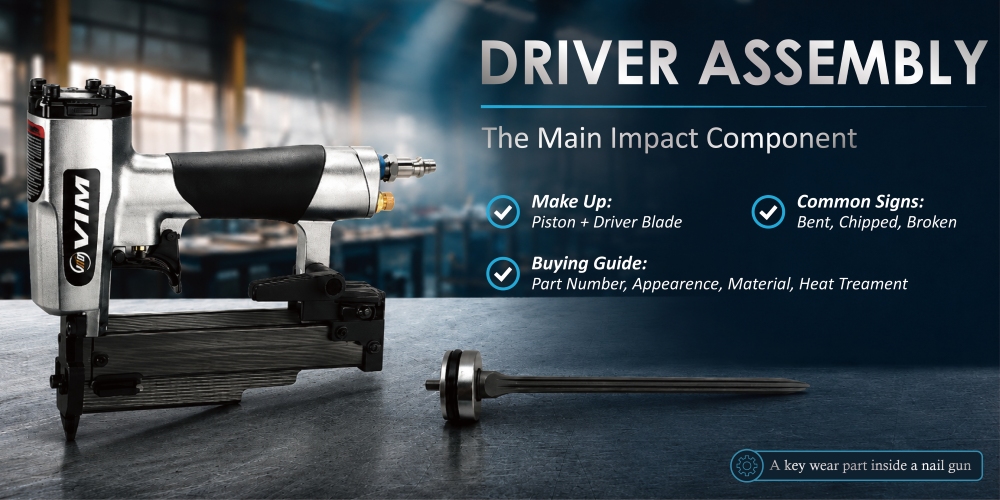
The driver assembly is one of the key moving components inside a nail gun. It is typically made up of a piston and driver blade, which move together during each firing cycle. When compressed air drives the piston downward, the driver blade transfers that force directly to the nail or staple and pushes it into the workpiece.
Because the driver assembly is exposed to repeated high-impact loads, the blade and piston can gradually wear, deform, or become damaged over time.
【Extended reading: The Most Popular Driver Assemblies: How to Choose and Where to Get Them】
Common Signs of a Worn Damaged Driver Assembly
A damaged driver assembly can affect both driving performance and tool reliability. Common signs include:
- Driver blade is bent, chipped, or broken
- Fasteners are not driven completely
- Nail gun fires but does not drive the fastener
- Frequent fastener jams
- Driver blade becomes stuck in the nosepiece
If these symptoms appear repeatedly, the driver assembly should be inspected for visible wear, deformation, or damage before other components are replaced.
【Extended reading: 5 Common Driver Unit Problems Every Air Nailer User Should Know】
How to Choose a Right Driver Assembly
Choosing the correct replacement is important because even small differences in dimensions or blade design can affect compatibility and tool performance. The following factors should be checked before ordering:
- Part number
Check the part number in the exploded view and spare part list for the nail gun model. This is usually the most reliable way to identify the correct replacement. - Appearance
Compare the replacement with the original driver assembly, including the piston diameter, blade shape, blade width, thickness, and overall length. Nailers commonly use rounded driver blades, while staplers often use flatter blades, but the exact design should always be verified by model. - Material
Driver assemblies are commonly made from high-strength tool steels such as S7, S2, SKD61, and DC53, depending on the design and performance requirements. These materials are selected for their combination of impact resistance, toughness, hardness, and wear resistance. Since the driver blade repeatedly strikes fasteners at high speed, the material must be strong enough to resist bending and wear while still maintaining sufficient toughness to avoid cracking or breakage. - Heat Treatment
Proper heat treatment helps balance hardness and toughness. If the blade is too soft, it may wear or deform quickly; if it is too hard, it may become brittle and more likely to crack or break under repeated impact.
【Extended reading: What Is Driver Blade? Accomplished Knowledge in Original vs. Aftermarket!】
Bumper – Protecting the Piston and Internal Components
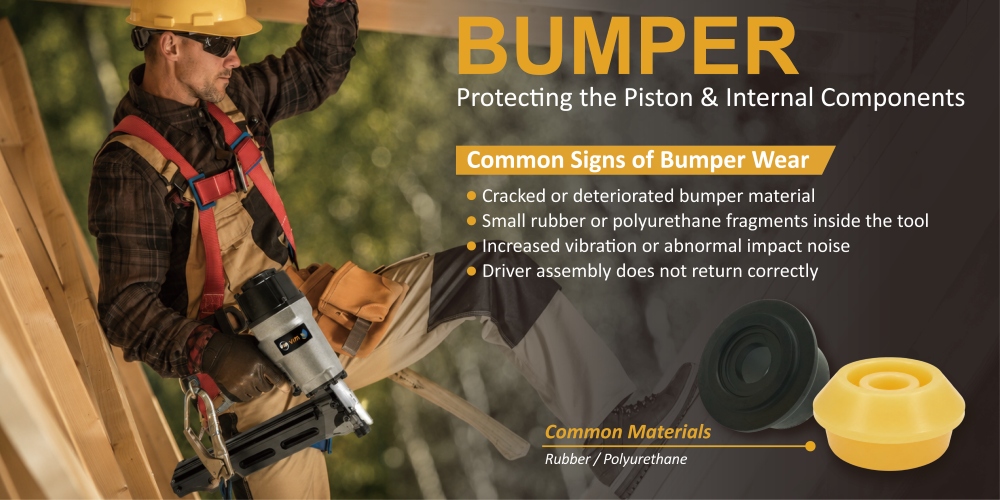
The bumper, sometimes also called a stopper, is an important cushioning component inside a nail gun. It is positioned near the bottom of the piston stroke and absorbs the impact when the piston and driver assembly reach the end of each firing cycle.
By reducing the shock generated during operation, the bumper helps protect the piston, driver assembly, cylinder, and tool body from excessive impact and vibration. Although it is a relatively small part, its condition can directly affect the durability and operating stability of the nail gun.
【Extended reading: Beyond OEM: 6 Reasons Why More Distributors Are Switching to Aftermarket Bumpers】
Common Signs of Bumper Wear
A worn or deteriorated bumper may no longer absorb impact effectively and can eventually affect other internal components. Common signs include:
- Cracked or deteriorated bumper material
- Small rubber or polyurethane fragments inside the tool
- Increased vibration or abnormal impact noise
- Driver assembly does not return correctly
How to Choose a Suitable Bumper
When selecting a replacement bumper, compatibility and material are two of the most important factors to check.
- Part number
Check the part number in the exploded view and spare part list for the nail gun you are using. Matching the correct part number is usually the most reliable way to ensure proper fit and function. - Material
Nail gun bumpers are commonly manufactured from rubber or polyurethane (PU). Rubber generally provides good elasticity and vibration absorption, while polyurethane is often selected for its durability, wear resistance, and resistance to repeated impact. The most suitable material depends on the original tool design and operating conditions.
【Extended reading: The 2 Leading Nail Gun Bumper Materials You Don’t Want to Overlook】
O-Rings – Small Seals That Prevent Major Air Leaks
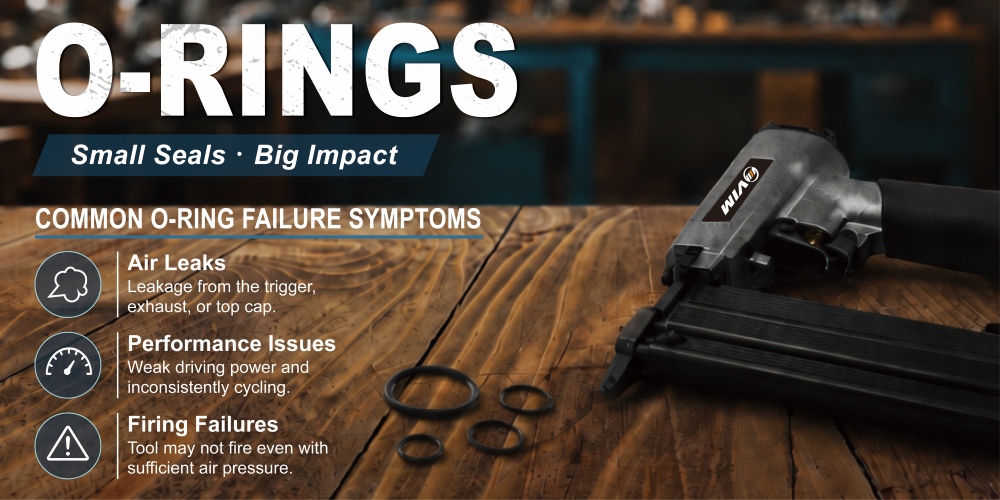
O-rings, also commonly referred to as seals, help prevent compressed air from escaping between internal chambers of a pneumatic nail gun. They are widely used around pistons, cylinders, trigger valves, head valve systems, and other moving or sealing components.
Although O-rings are small and relatively inexpensive, they play an important role in maintaining air pressure and stable tool performance. As they age, harden, crack, or wear, air can begin to leak through the pneumatic system and reduce the efficiency of the nail gun.
Common O-Ring Failure Symptoms
Worn or damaged O-rings can cause several common operating problems, including:
- Air leaking from the trigger
- Air leaking from the exhaust
- Air leaking around the top cap
- Weak driving power
- Tool cycles inconsistently
- Nail gun does not fire despite having sufficient air pressure
The location of the air leak can often help narrow down which sealing area needs inspection. However, technicians should check the surrounding O-rings, valves, and related components before replacing parts, as similar symptoms may have more than one possible cause.
【Extended reading: Nail Gun Leaking Air from Trigger? Step-by-Step Fix & Prevention】
Cylinder Cap Seal – Maintaining Proper Air Pressure and Sealing
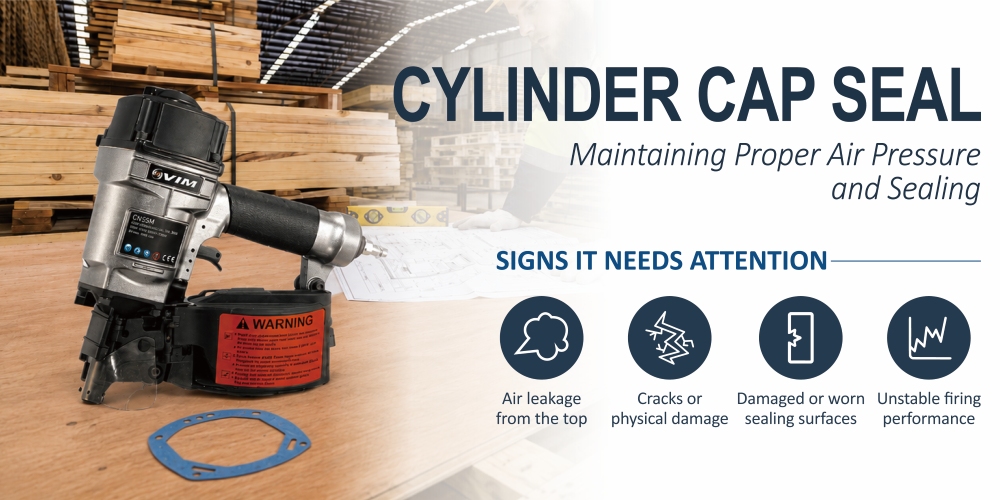
The cylinder cap seal, sometimes referred to as the top cap or head cap depending on the nail gun design, closes and seals the upper section of the pneumatic system. It helps maintain proper air pressure inside the tool and supports the operation of components involved in the firing and exhaust cycle.
Depending on the nail gun design, the cylinder cap seal may work together with O-rings, head valves, springs, and exhaust components. Damage to the cap itself, its sealing surfaces, or the related internal parts can lead to air leakage and unstable tool performance.
Signs That the Cylinder Cap Seal or Related Components Need Attention
Common signs include:
- Persistent air leakage from the top of the nail gun
- Cracks or physical damage
- Damaged or worn sealing surfaces
- Unstable or inconsistent firing performance
【Extended reading: Nailer Parts Guide: How to Ensure Compatibility and Avoid Costly Mistakes】
Trigger Valve Assembly – A Common Cause of Air Leakage and Firing Problems
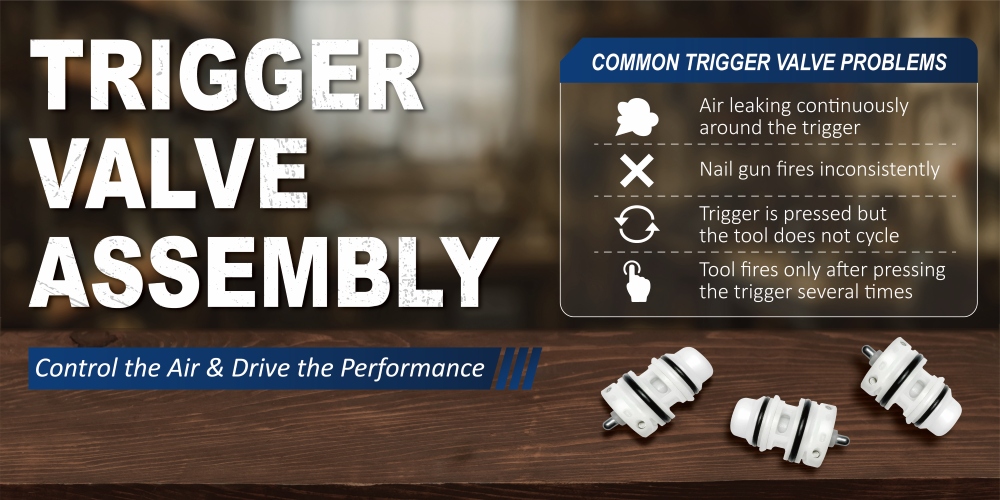
The trigger valve assembly controls the pneumatic signal that starts the firing cycle of a nail gun. When the trigger is pressed, the valve redirects compressed air to activate the internal firing mechanism and drive the piston.
Because the trigger valve is operated every time the tool fires, its seals, O-rings, and internal components are exposed to repeated movement and air pressure. Over time, wear or contamination can lead to air leakage, delayed response, or inconsistent firing.
Common Trigger Valve Problems
Common signs of a worn or faulty trigger valve assembly include:
- Air leaking continuously around the trigger
- Nail gun fires inconsistently
- Trigger is pressed but the tool does not cycle
- Tool fires only after pressing the trigger several times
【Extended reading: Air Nailer Troubles? 6 Trigger Issues and How to Fix Them】
FAQ
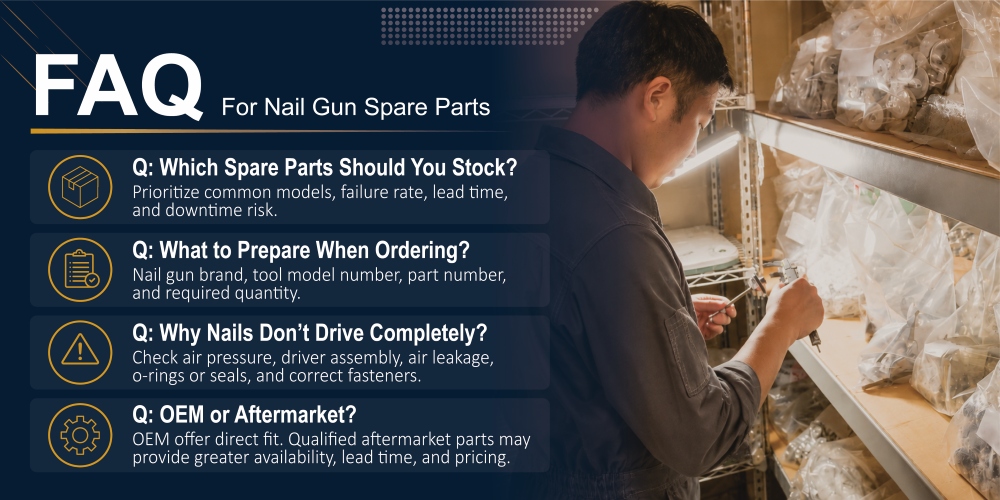
Q: How to Decide Which Nail Gun Spare Parts to Keep in Stock?
Workshops do not need to stock every spare part for every nail gun. A more practical approach is to prioritize parts based on the nail gun models used most frequently, the failure rate of each component, replacement lead time, and whether a failure can stop the tool completely.
For commonly serviced models, driver assemblies, bumpers, O-rings, cylinder cap seals, and trigger valve assemblies are useful parts to consider keeping available.
【Extended reading: What Technicians Don’t Tell You: 6 Moves to Fixing Driver Units and Restoring Nailers】
Q: What Information Do I Need When Ordering Nail Gun Repair Parts?
Before ordering replacement parts, prepare the nail gun brand, tool model number, part number, and required quantity.
If the part number is unavailable, providing dimensions and photos from different angles can also help the supplier identify the correct replacement more accurately.
【Extended reading: What Happens When a Driver Blade Fails? Lessons from the Paslode 901078】
Q: Why Does My Nail Gun Fire but Not Drive Nails Completely?
Possible causes include insufficient air pressure, a worn or damaged driver assembly, internal air leakage, worn O-rings or seals, incorrect fasteners, or other pneumatic problems.
If the air pressure and fasteners are correct, inspect the driver blade and internal sealing components for wear or damage.
Q: Should I Choose OEM or Aftermarket Nail Gun Repair Parts?
OEM parts offer direct compatibility with the original tool specification, while qualified aftermarket parts may provide greater availability, shorter lead times, or more competitive pricing.
When choosing an aftermarket spare part, check the part number, dimensions, material, manufacturing quality, and compatibility with the exact nail gun model. For parts such as driver assemblies and bumpers, material quality and production consistency are especially important for service life and performance.
【Extended reading: 6 Truths About Aftermarket Air Stapler Parts and Air Nailer Parts】
Conclusion
Keeping the right nail gun repair parts in stock can make a significant difference when a tool suddenly develops air leaks, driving problems, or internal wear. Instead of replacing the entire nail gun, many common issues can be resolved by identifying and replacing the correct driver assembly, bumper, O-ring, cylinder cap seal, trigger valve assembly, or other spare part.
For workshops, distributors, and repair centers, a practical spare parts inventory can help reduce downtime, speed up repairs, and extend the service life of nail guns.
VIM supplies aftermarket spare parts for nail guns and staplers. If you are looking for a particular replacement part, simply contact us with the nailer brand, tool model, part number, and required quantity, and we can help check the available replacement options.
Article Classification
Recent Articles
- Nail Gun Repair Essentials: 5 Spare Parts Worth Stocking
- Nailer Parts Guide: How to Ensure Compatibility and Avoid Costly Mistakes
- The Most Popular Driver Assemblies: How to Choose and Where to Get Them
- The 2 Leading Nail Gun Bumper Materials You Don’t Want to Overlook
- Maximize Tool Performance: 4 Smart Ways to Pick the Best Air Tool Fittings