
INSIGHT

- Home
- INSIGHT
- Refillable Spray Can
- Practical Ways to Use Refillable Spray Cans in Industry
Practical Ways to Use Refillable Spray Cans in Industry
July 30,2026
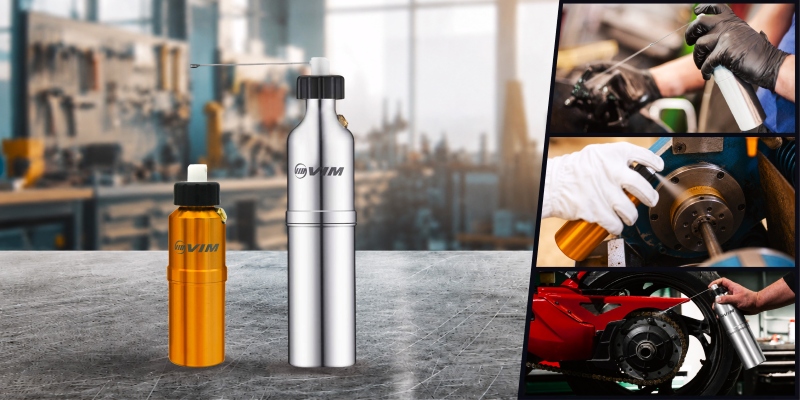
Refillable spray cans provide a reusable and portable way to apply compatible bulk liquids during industrial lubrication, cleaning, degreasing, and corrosion-protection work. By using compressed air, they can dispense liquids as either a controlled mist for broader coverage or a concentrated stream for targeted areas.
For industrial facilities that frequently use disposable aerosol cans or already purchase maintenance liquids in bulk, refillable spray cans can offer greater application flexibility and reduce dependence on single-use packaging. This article explains their working principle, practical industrial applications, main advantages, and the key factors to consider when selecting a suitable model.
What Is an Industrial Refillable Spray Can?
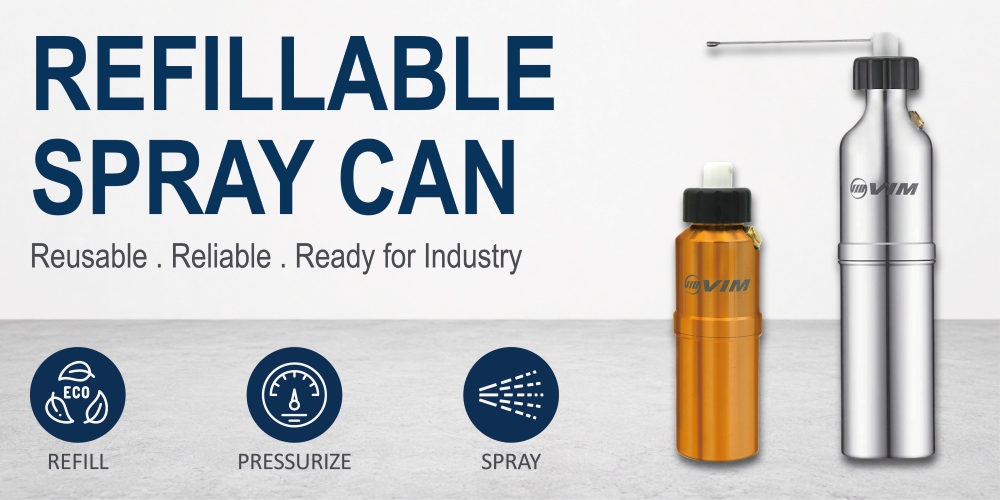
An industrial refillable spray can is a reusable container that can be filled with a compatible liquid and pressurized with compressed air. Unlike disposable aerosol cans, refillable spray cans can be depressurized, refilled, pressurized again, and reused for repeated maintenance and spraying tasks. They are commonly used with approved lubricants, cleaners, penetrating fluids, corrosion-prevention liquids, and other compatible industrial fluids.
【Related product: Refillable Spray Can】
Main Components
Refillable spray cans consist of several components that work together to store, pressurize, and dispense liquids safely and efficiently.
The main components normally include:
- Aluminum or metal container: Holds the liquid and compressed air while providing the structural strength required for pressurized operation.
- Spray valve: Controls the release of the pressurized liquid when the actuator is pressed.
- Mist nozzle or stream nozzle: Determines the spray pattern and allows the liquid to be applied over a wider area or directed toward a specific location.
- Replaceable seals and O-rings: Help maintain an airtight seal and prevent leakage between connected components.
- Pressure relief valve: Helps release excessive internal pressure when it exceeds the designed safety threshold.
- Air inlet or charging valve: Allows the container to be pressurized using an approved compressed-air source or charging device.
- Dip tube: Draws the liquid from the bottom of the container toward the spray valve during operation.
Basic Working Principle
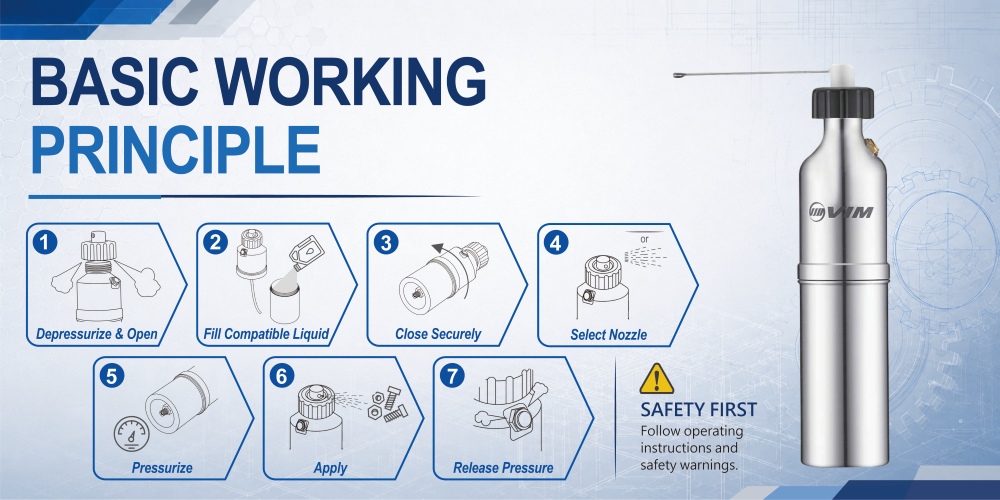
A refillable spray can operates by using compressed air to force the liquid through the dip tube, spray valve, and nozzle. When the spray valve is activated, the pressure inside the container pushes the liquid upward and releases it as either a mist or a concentrated stream.
Incorrect filling, pressurization, or handling may result in leakage, equipment damage, uncontrolled pressure release, or personal injury. Users should therefore read the manufacturer’s operating instructions and safety warnings before use.
The general operating process is as follows:
1. Fully depressurize and open the spray can.
2. Fill the container with a compatible liquid according to the recommended filling capacity.
3. Close and secure the container correctly.
4. Select the appropriate spray nozzle.
5. Pressurize the spray can with an approved air source.
6. Apply the liquid to the required surface or component.
7. Release the pressure before opening, cleaning, refilling, or servicing the spray can.
【Related product: Air Inflating Base】
Why Are Refillable Spray Cans Used in Industry?
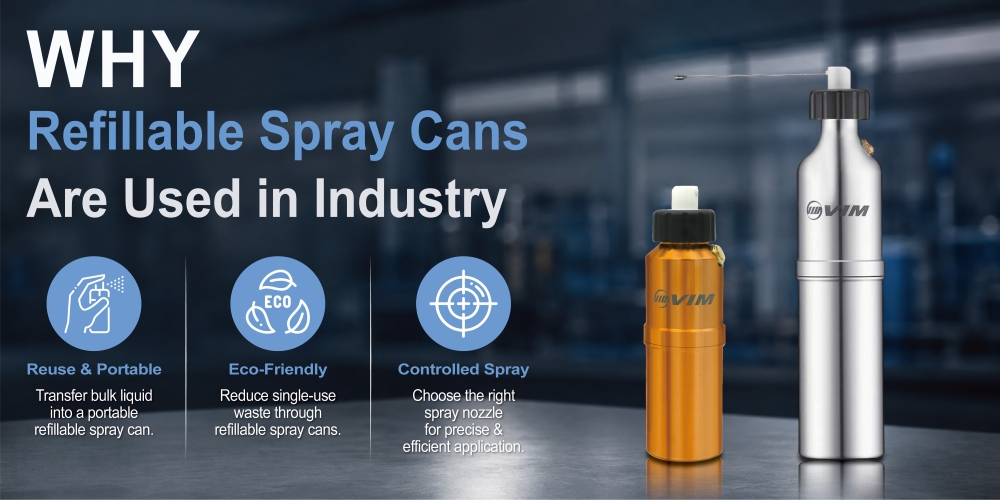
Refillable spray cans provide a practical and portable way to dispense compatible industrial liquids during routine maintenance, cleaning, lubrication, and repair work. They are particularly useful when operators need to apply a controlled amount of liquid at different locations without carrying large bottles, drums, or other bulk containers around the workplace.
Reuse of Bulk Industrial Liquids
Industrial lubricants, cleaners, degreasers, penetrating fluids, and corrosion-prevention products are often purchased in bottles, cans, pails, drums, or other bulk packaging. Although bulk purchasing may be practical for storage and procurement, these large containers are not always convenient for daily maintenance work.
A refillable spray can allows operators to transfer a smaller quantity of a compatible bulk liquid into a portable dispensing container. The liquid can then be carried directly to machinery, vehicles, tools, production lines, or other equipment requiring maintenance.
Reduced Dependence on Disposable Aerosol Packaging
Disposable aerosol cans are convenient because they are supplied pre-filled and ready to use. However, industrial facilities that regularly perform cleaning, lubrication, or maintenance work may consume a considerable number of single-use cans over time.
Refillable spray cans allow compatible liquids to be purchased in bulk and dispensed through a reusable container. This can reduce a company’s dependence on individually packaged aerosol products for suitable applications.
The actual economic and environmental benefits will vary according to the application. Factors such as bulk-liquid cost, aerosol-can cost, consumption volume, filling labor, cleaning requirements, compressed-air use, replacement parts, and local disposal practices should all be considered. A refillable system is generally most practical when the same compatible liquid is used regularly and the company can establish proper procedures for filling, labeling, pressurizing, cleaning, inspecting, and maintaining the container.
【Extended reading: Smarter Spray Solutions – 4 Ways to Choose Between Refillable and Disposable Spray Cans】
Controlled Spray Application
Many refillable spray cans allow operators to select different nozzles according to the intended application. Choosing the correct spray pattern can improve coverage, help operators reach restricted areas, and reduce unnecessary liquid application.
For example, VIM refillable spray cans are supplied with two different nozzles:
- Full-cone nozzle: Produces a mist spray for broader and more even surface coverage.
- Solid-stream nozzle: Produces a concentrated stream for targeted applications and difficult-to-reach areas.
The mist nozzle can distribute a small amount of liquid over a wider area, while the solid-stream nozzle provides greater directional control when the liquid must be delivered to a specific point. This nozzle flexibility allows one refillable spray can design to support a wider range of industrial maintenance and cleaning tasks.
Major Industrial Applications of Refillable Spray Cans
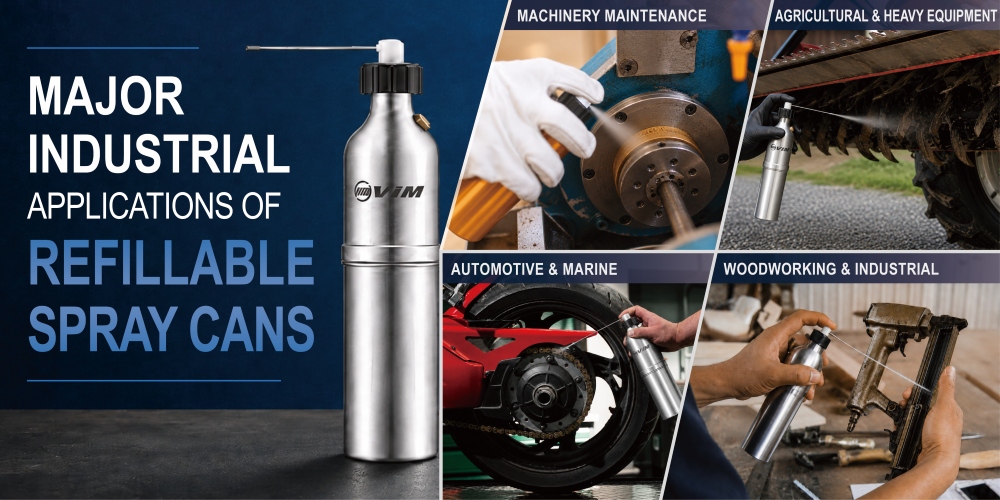
Refillable spray cans are used across a wide range of industries to apply compatible lubricants, cleaners, degreasers, penetrating oils, and corrosion-prevention fluids during routine maintenance and repair work.
Their portability and reusable design make them particularly suitable for routine maintenance tasks performed in factories, workshops, construction sites, farms, vehicle service centers, and other industrial environments.
【Extended reading: Refillable Spray Can: The Future of Sustainable Refilling Solutions】
Machinery, Agricultural, and Heavy-Equipment Maintenance
Maintenance technicians can use refillable spray cans to carry and apply compatible bulk lubricants, penetrating fluids, cleaners, and other maintenance products without moving large liquid containers around factories, construction sites, farms, or equipment yards.
Typical applications include:
- Lubricating moving machine components
- Applying light machine oil
- Lubricating hinges, bearings, chains, and linkages
- Applying penetrating fluids to rusted or seized components
- Maintaining pneumatic and mechanical equipment
- Servicing tractors, excavators, loaders, and harvesting equipment
- Removing dirt, oil, and residue from mechanical components
- Reaching narrow or difficult-to-access areas
【Extended reading: 4 Simple Ways to Maintain Your Hog Ring Plier for Better Performance】
Automotive, Fleet, Marine, and Corrosion-Protection Maintenance
Automotive workshops, fleet maintenance departments, heavy-vehicle service centers, and marine maintenance facilities may use refillable spray cans for repeated cleaning, lubrication, and corrosion-prevention tasks.
The ability to apply either a fine mist or a concentrated stream allows technicians to cover broad surfaces or direct the liquid toward specific components, joints, and recessed areas.
Typical applications include:
- Supporting brake and component servicing
- Performing chassis maintenance
- Cleaning metal components
- Applying penetrating oil to rusted fasteners
- Lubricating hinges, joints, and mechanical parts
- Removing oil, dirt, and workshop residue
- Applying rust-prevention fluids
- Applying approved corrosion inhibitors
- Protecting exposed metal components
- Treating suitable components exposed to moisture or salt
- Preparing vehicles, machinery, or marine equipment for storage
Woodworking and Furniture Manufacturing
Refillable spray cans may be used in woodworking shops and furniture factories to support routine maintenance of production equipment, pneumatic tools, and mechanical adjustment points.
Typical applications include:
- Cleaning woodworking machinery
- Removing dust, oil, and residue from compatible equipment surfaces
- Lubricating mechanical adjustment points
- Maintaining pneumatic tools
- Applying oil to hinges and moving parts
- Protecting exposed metal components from corrosion
- Supporting preventive maintenance of assembly equipment
【Extended reading: Narrow vs. Wide Crown Stapler: 3 Steps to Make the Right Choice】
Industrial Cleaning and Degreasing
Cleaning and degreasing are among the most common applications of refillable spray cans. Maintenance teams can fill the container with an approved bulk cleaner or degreasing liquid and use it to deliver either a fine mist or a concentrated stream. Depending on the cleaning task, operators can use a fine mist for broader coverage or a concentrated stream for localized and difficult-to-reach areas.
Compared with pouring cleaner directly from a bottle, a refillable spray can gives the operator greater control over the amount and location of the liquid being applied. This may help reduce unnecessary consumption, overspray, and liquid runoff, particularly when only a small or localized area requires cleaning.
Typical applications include:
- Removing grease from machinery and production equipment
- Cleaning tools after maintenance or production work
- Degreasing parts before inspection or assembly
- Removing workshop dirt, dust, and residue
- Cleaning narrow or difficult-to-reach areas
- Flushing residue from joints, gaps, recesses, and mechanical components
- Cleaning components before inspection, lubrication, or assembly
- Cleaning small batches of machined or fabricated parts
How to Select a Suitable Refillable Spray Can for Industrial Use
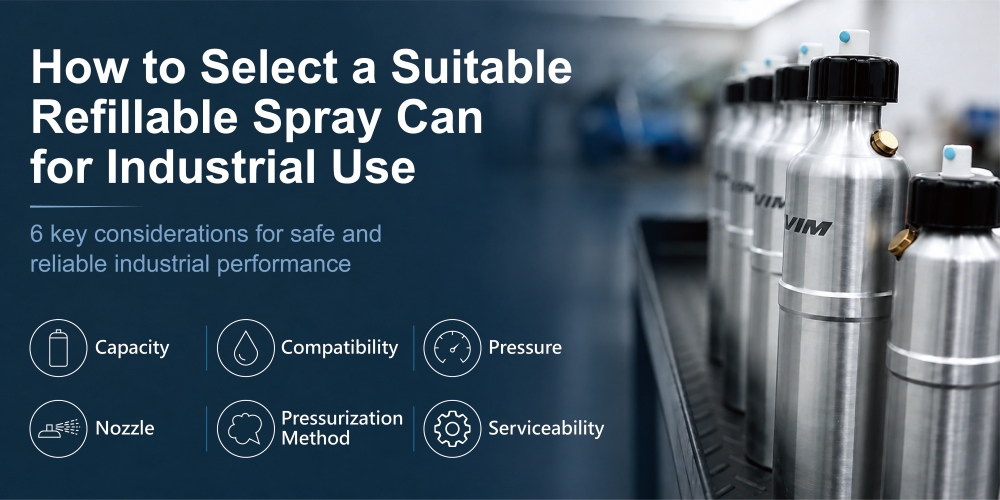
Selecting a refillable spray can involves more than choosing the container size. The intended liquid, working pressure, nozzle type, sealing materials, pressurization method, and maintenance requirements should all be considered to ensure safe and reliable performance.
1. Container Capacity
Choose the capacity according to daily consumption, spray duration, refill frequency, and portability. The total container volume is not the same as the recommended liquid filling capacity, as sufficient internal space must remain for compressed air. A smaller model is easier to carry and use in restricted areas, while a larger model may reduce interruptions during higher-consumption tasks.
【100ml option: AR100 Refillable Spray Can】
【250ml option: AR250 Refillable Spray Can】
2. Container and Seal Compatibility
The intended liquid must be compatible with the container body, valve, dip tube, nozzle, seals, and O-rings. Compatibility may be affected by the liquid’s chemical composition, pH value, solvent content, viscosity, temperature, and contact duration. Because liquids within the same general category may have different formulations, a controlled compatibility test is recommended whenever suitability cannot be confirmed.
VIM refillable spray cans feature an aluminum body and are designed for temporary contact of up to 12 hours with compatible liquids having a pH value between 4 and 12. We also offer NBR O-rings and Viton (FKM) O-rings to accommodate different liquid formulations and application requirements.
3. Working Pressure
The working pressure affects spray distance, flow rate, and spray pattern. Users should follow the manufacturer’s recommended pressure range and never exceed the maximum rated pressure. Higher pressure does not always improve performance, as the result also depends on the liquid viscosity, nozzle design, valve system, filling volume, and temperature. A regulated air source should always be used for safe and consistent pressurization.
4. Spray Nozzle Options
Select the nozzle according to the required spray pattern. A full-cone nozzle is suitable for broader coverage, while a solid-stream nozzle provides targeted application to joints, fasteners, narrow gaps, and recessed components.
5. Pressurization Method
Refillable spray cans can be pressurized using a regulated air compressor, a manual air pump, or a dedicated charging device, depending on the working environment and frequency of use.
For faster and more consistent pressurization, VIM offers an air inflating base. Simply insert the spray can into the base, and the pressurization process is completed in approximately three seconds. Once the target pressure is reached, the base automatically stops supplying air, helping provide consistent pressurization and prevent continued over-pressurization.
【Related video: Demonstration of the VIM Air Inflating Base】
6. Replaceable Components and Serviceability
A refillable spray can should be easy to inspect, clean, and maintain. Buyers should check whether replacement O-rings, seals, nozzles, valves, and dip tubes are available. Replaceable parts can extend the product’s service life and reduce downtime. Components should be inspected regularly and replaced if they become swollen, hardened, cracked, worn, blocked, or unable to maintain pressure.
Frequently Asked Questions
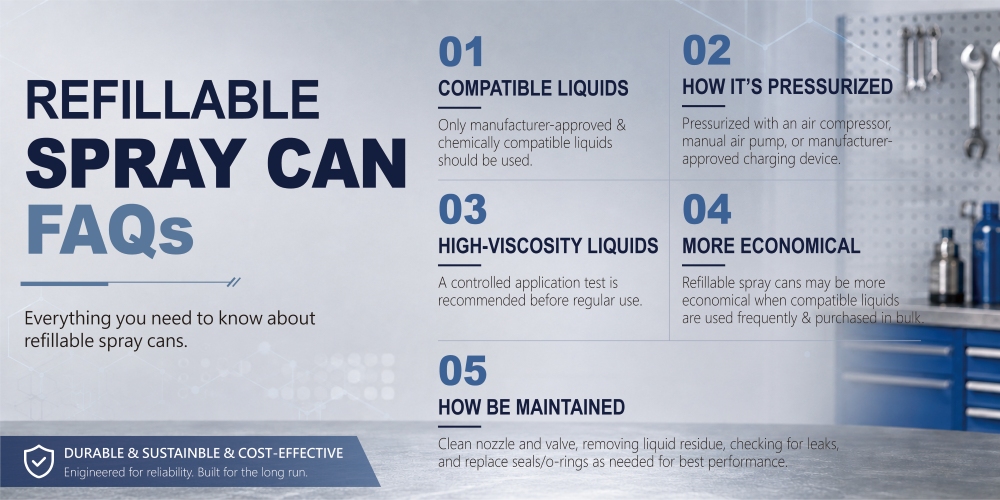
Q: What Liquids Can Be Used in Refillable Spray Cans?
Only manufacturer-approved and chemically compatible liquids should be used. VIM refillable spray cans are designed for compatible liquids with a pH value between 4 and 12, subject to the specified material and contact-time limitations.
Q: How Is a Refillable Spray Can Pressurized?
A refillable spray can may be pressurized using a regulated air compressor, manual air pump, or manufacturer-approved charging device. Always follow the specified pressure limit.
Q: Are Refillable Spray Cans Suitable for High-Viscosity Liquids?
Suitability depends on the liquid viscosity, nozzle opening, valve design, dip tube, and working pressure. High-viscosity liquids may spray unevenly or block the nozzle, so a controlled application test is recommended before regular use.
Q: Are Refillable Spray Cans More Economical Than Disposable Aerosol Cans?
They may be more economical when compatible liquids are used frequently and purchased in bulk. Actual savings depend on liquid cost, usage volume, filling labor, compressed-air consumption, maintenance, and the service life of the spray can.
Q: How Should Refillable Spray Cans Be Maintained?
The spray can should be fully depressurized before cleaning, refilling, or servicing. Regular maintenance includes cleaning the nozzle and valve, removing liquid residue, checking for leaks, and inspecting the seals and O-rings. Damaged, hardened, swollen, or worn components should be replaced promptly to maintain safe and reliable operation.
【Extended reading: How to Repair and Maintain Refillable Spray Cans for Longevity: VIM AR250 & AR100 Maintenance Guide】
Conclusion
Refillable spray cans offer a practical way to apply compatible bulk liquids during industrial maintenance, lubrication, cleaning, degreasing, and corrosion-protection work. Their reusable design, portability, and interchangeable spray nozzles make them suitable for a variety of applications in factories, workshops, farms, vehicle service centers, and other industrial environments.
Selecting the right refillable spray can requires careful consideration of the intended liquid, container capacity, material compatibility, working pressure, nozzle type, pressurization method, and availability of replacement parts. Proper filling, pressurization, cleaning, and maintenance are also essential for safe and reliable operation.
VIM offers refillable spray cans in two capacities: 100 ml and 250 ml. We also provide different O-ring options, interchangeable mist and stream nozzles, and an air charging solution for efficient pressurization. Contact us to discuss your intended liquid, application requirements, private-label needs, or sample-testing project. Our team will help you identify a suitable solution.
Article Classification
Recent Articles
- Practical Ways to Use Refillable Spray Cans in Industry
- Smarter Spray Solutions – 4 Ways to Choose Between Refillable and Disposable Spray Cans
- How to Repair and Maintain Refillable Spray Cans for Longevity : VIM AR250 & AR100 Maintenance Guide
- Refillable Spray Can: The Future of Sustainable Refilling Solutions