
INSIGHT

Coil Nailer vs. Strip Nailer: Which One Is Right for Your Job?
September 11,2026
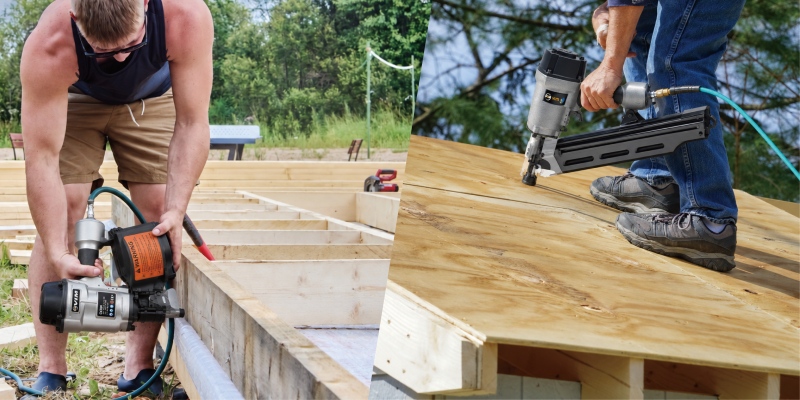
Which is the better choice for your job: a coil nailer or a strip framing nailer? Although both tools are designed for fastening work, the way their nails are arranged and loaded creates clear differences in magazine capacity, tool profile, collation type, nail angle, and typical applications. Choosing the wrong system may lead to more frequent reloading, limited access in certain working areas, or incompatibility with the fasteners you plan to use.
In this article, we will compare coil nailers and strip nailers side by side, covering their nail capacity, collation systems, magazine angles, typical uses, and the key factors to consider when choosing between them.
What Are Coil Nailers and Strip Nailers?
Coil nailers and strip nailers differ mainly in how their nails are arranged and loaded into the nail gun. Coil nailers use nails wound into a coil, while strip nailers use nails arranged in straight strips. This difference influences magazine capacity, tool profile, fastener type, and typical applications.
【Related product: Coil Nailer】
【Related product: Framing Nailer】
Coil Nailer
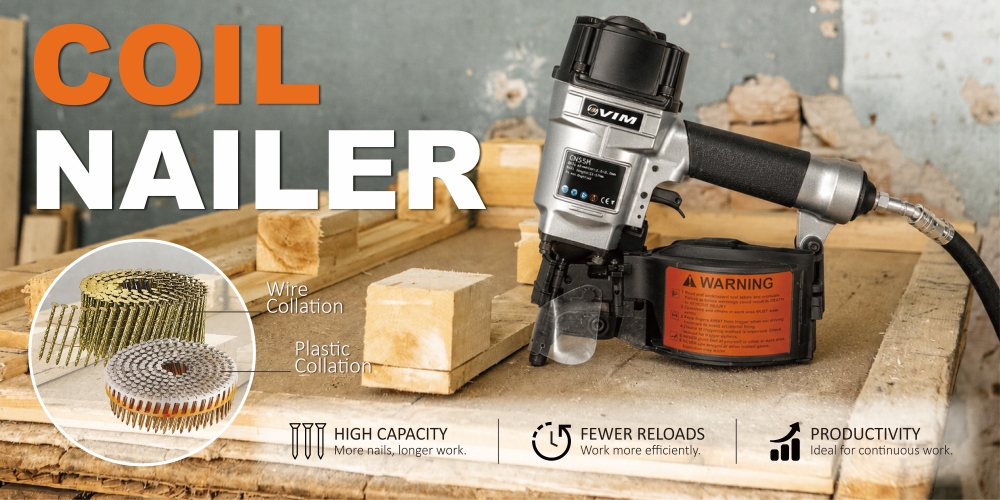
A coil nailer uses nails that are connected together and wound into a coil. These coil nails are commonly available with wire or plastic collation. The fasteners are loaded into a round or drum-style magazine, allowing a relatively large number of nails to be stored in a compact space.
Because of its higher nail capacity, a coil nailer generally requires fewer reloads during continuous fastening work. This makes it especially suitable for applications where productivity and uninterrupted operation are important.
【Extended reading: 10 Revolutionary Tips for Choosing Coil Nail Guns in Construction】
Strip Nailer
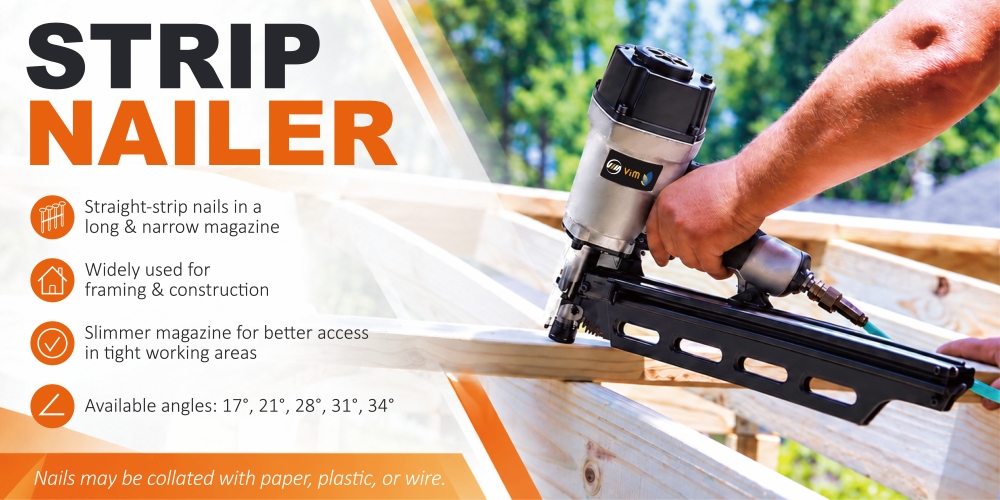
A strip nailer, also commonly called a stick nailer, uses nails arranged in straight strips that are loaded into a long, narrow magazine. Strip nailers are widely used for framing and other construction applications. Depending on the fastener system, the nails may be collated with paper, plastic, or wire.
Compared with a coil nailer, a strip nailer usually holds fewer nails at one time, but its slimmer magazine design can provide better access in certain working areas.
Strip nailers are available in different magazine angles, such as 17°, 21°, 28°, 31°, and 34°, depending on the nail type and collation system.
【Extended reading: Every Tip for Choosing the Best Framing Nailer】
Coil Nailer vs. Strip Nailer: Key Differences at a Glance
| Features | Coil Nailer | Strip Framing Nailer |
|---|---|---|
| Nail Arrangement | Wound into a coil | Arranged in straight strips |
| Magazine Design | Round or drum-style | Long & narrow magazine |
| Nail Capacity | Higher | Lower |
| Reloading Frequency | Less | More |
| Common Collation Types |
‧ Wire ‧ Plastic |
‧ Wire ‧ Plastic ‧ Paper |
| Common Magazine Angles |
‧ 0-degree ‧ 15-degree (16-degree) |
‧ 17-degree ‧ 21-degree ‧ 28-degree ‧ 31-degree ‧ 34-degree |
| Typical Use | Continuous and high-volume fastening | Framing and general construction |
| Advantage | Fewer reloads and better workflow efficiency | Slimmer profile and better access in some working areas |
Nail Capacity and Reloading Frequency
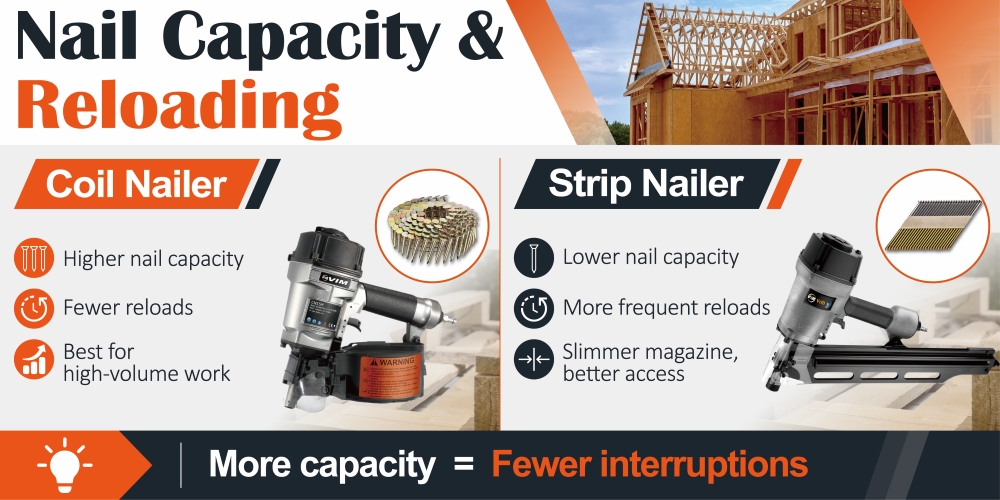
One of the main advantages of a coil nailer is its higher nail capacity. Since the nails are wound into a coil, more fasteners can be loaded into the magazine without requiring a long magazine body. This reduces the frequency of reloading and helps maintain a more continuous workflow, especially in high-volume applications such as pallet production, fencing, siding, and roofing.
Strip nailers hold fewer nails because the fasteners are arranged in straight strips. As a result, they generally require more frequent reloading during continuous fastening work. However, their narrower magazine profile can be more practical in framing and other construction applications where access and maneuverability are important.
Higher nail capacity does not necessarily mean a faster firing speed; its main benefit is reducing interruptions during operation.
【Extended reading: 3 Common Magazine Issues in Air Nailers and How to Fix Them】
Nail Collation Types
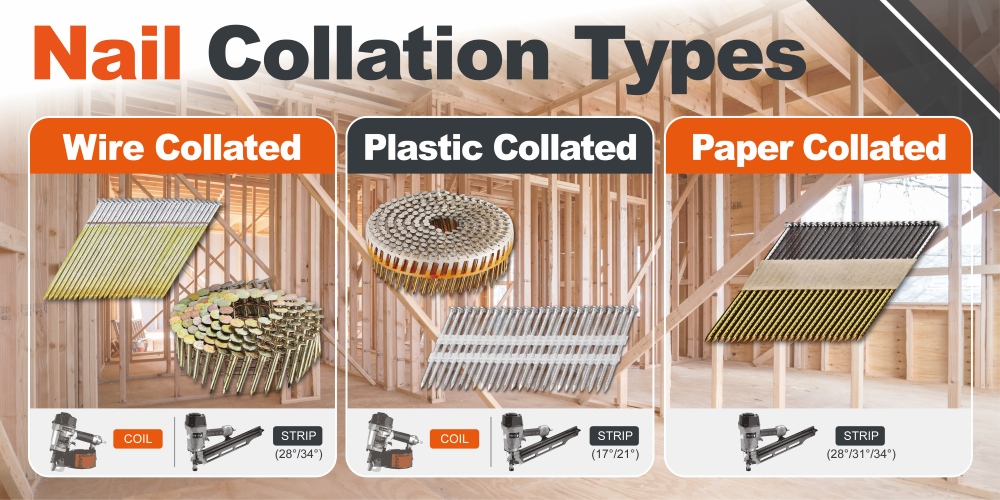
Coil nailers and strip nailers can use different collation systems, with each type designed to suit different tool structures and fastening requirements.
Some nailers are designed to accept more than one collation type. For example, the VIM CN50M 2-In-1 Wire and Plastic Collated Coil Nailer can use both wire- and plastic- collated nails, provided that the nail dimensions, angle, and lengths are compatible with the nail gun.
Wire Collated Nails
Wire-collated nails are held together by thin metal wires. They provide a strong and stable connection between the nails and are commonly used in coil nailers. Wire-collated nails are also available for certain 28-degree and 34-degree strip framing nailers, depending on the specific tool design.
Because the welded wire is less affected by humidity or temperature changes, wire-collated nails are especially reliable in demanding outdoor conditions and on jobsites exposed to moisture. Their rigid collation also helps maintain consistent feeding during continuous operation.
【Extended reading: Choosing the Right Coil Nails: 8 Essential Factors for Your Project】
Plastic Collated Nails
Plastic-collated nails are connected by molded plastic strips. They are commonly manufactured with full round heads, which require more spacing between adjacent nails. To accommodate this spacing, the plastic carrier is designed to break away cleanly as each nail is driven. Plastic-collated nails are available in both coil nailers and strip nailers, depending on the nail gun design.
【Extended reading: A Deep Dive into Coil Nails: 5 Reasons You Should Choose Coil Nails】
Paper Collated Nails
Paper-collated nails are held together with paper tape. This collation type is commonly used with clipped-head or offset full round head nails, allowing the nails to be positioned more closely together.
They are primarily used with 28-degree, 31-degree, or 34-degree strip nailers, depending on the nailer design and regional standards. The paper collation allows the nails to be packed closely together, contributing to a slimmer magazine profile while leaving less collation material around the fastener after driving.
【Extended reading: 8 Expert Facts on Strip Nails for Smarter Fastening Choices】
Nail Angle Differences
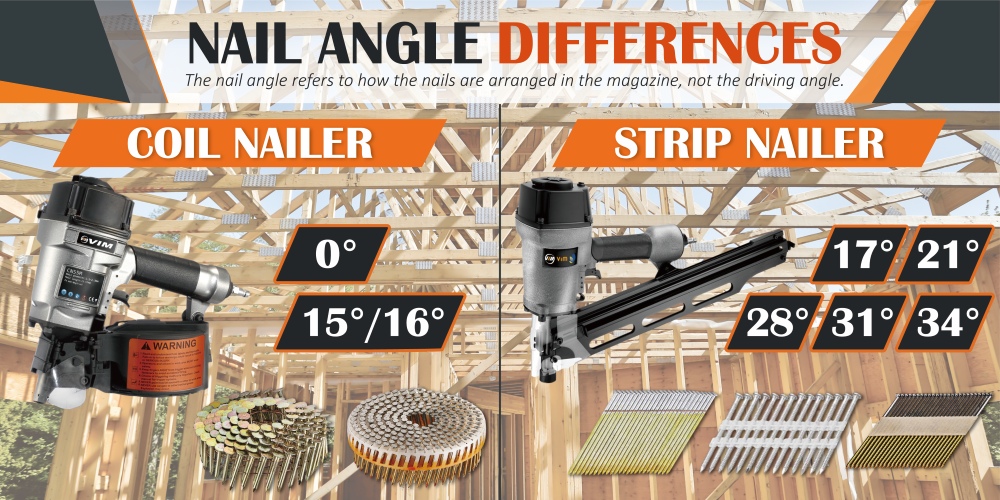
Another important difference between coil nailers and strip nailers is the angle of the fastener collation. The nail angle refers to how the nails are arranged and fed through the magazine; it does not mean that the nail is driven into the workpiece at that angle.
Coil Nailer Angles
Coil nailers are most commonly available in 0-degree and 15-degree (or 16-degree) configurations.
0-degree coil nailers use nails that are arranged almost straight in relation to the magazine and are commonly found in certain industrial or specialized fastening systems.
15-degree and 16-degree coil nailers are much more common in general construction and industrial applications. These tools typically use wire-collated or plastic-collated coil nails and are widely used for pallet production, fencing, siding, roofing, and other high-volume fastening work.
【Extended reading: Stop Wasting Your Time! 9 Coil Nail Hacks for Faster Roofing & Crates】
Strip Nailer Angles
Strip nailers are available in a wider range of magazine angles, including 17°, 21°, 28°, 31°, and 34°. The different angles are generally associated with different nail collation systems, head types, and magazine designs.
A steeper magazine angle can also help create a narrower tool profile, which may improve access between studs, joists, and other confined construction areas.
【Related product: Nails】
When Should You Use a Coil Nailer or Strip Nailer?
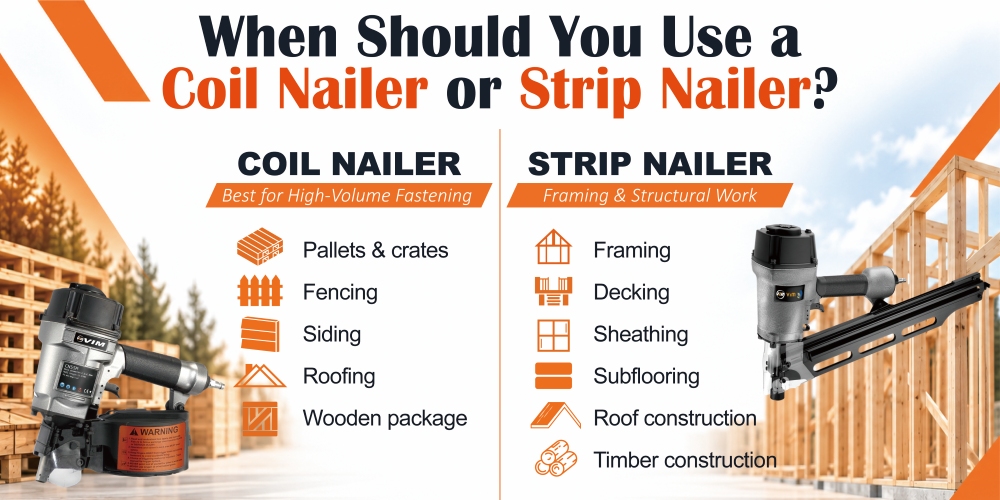
The choice between a coil nailer and a strip nailer mainly depends on the type of work, fastening volume, available working space, and the fastener specifications required for the application.
High-Volume Fastening – Coil Nailer
A coil nailer is generally the better choice when a large number of nails need to be driven continuously. Its higher magazine capacity reduces the need for frequent reloading, making it especially suitable for repetitive or production-oriented applications.
Typical applications include:
- Pallet and crate manufacturing
- Fencing
- Siding
- Roofing
- Wooden packaging
- Other continuous fastening applications
Framing and Structural Work – Strip Nailer
A strip nailer is commonly preferred for framing and structural construction. Its long, narrow magazine creates a slimmer tool profile, making it easier to position the nailer between studs, joists, trusses, and other confined structural areas.
Strip nailers are widely used for:
- Framing
- Decking
- Sheathing
- Subflooring
- Roof construction
- Timber construction
【Extended reading: All You Need to Know to Choose Your Perfect Air Nailers, Air Staple Guns, and Air Pliers】
FAQ
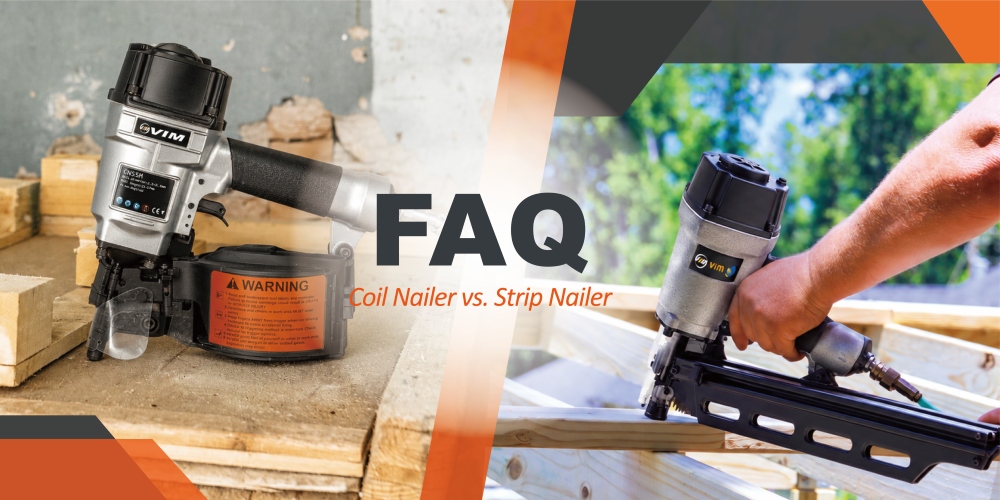
1. Can Coil Nails Be Used in A Strip Nailer?
No. Coil nails and strip nails use different magazine and feeding systems. Fasteners must match the nailer’s required collation type, angle, dimensions, and other specifications.
【Extended reading: Nails, Screws, or Staples? Why Wrong Fasteners Might Ruin Your Project】
2. Can One Nailer Use Different Collation Types?
Some models can. Certain nailers are designed to accept more than one collation type, such as both wire- and plastic-collated nails. However, the nail dimensions, angle, and tool specifications must still be compatible.
3. Which Type of Nailer Is Better for Framing?
Strip nailers are generally more common for framing and structural construction. Their angled, narrow magazine design makes them suitable for working around studs, joists, trusses, and other structural components.
【Extended reading: How to Extend Your Air Nailer’s Lifespan Across 3 Key Dimensions】
4. Which Nailer Is Better for Tight Spaces?
It depends on the working area. Strip nailers have a narrower magazine, which can provide better access between framing members, while coil nailers have a shorter magazine length that may be more convenient where a long strip magazine would get in the way.
Conclusion
Choosing between a coil nailer and a strip nailer depends on the type of work, fastening volume, available working space, and the fastener system required for the application.
Coil nailers are well suited for high-volume and continuous fastening tasks where fewer reloads can help improve workflow efficiency. Strip framing nailers, on the other hand, are commonly preferred for framing and structural construction, where a slimmer magazine profile and different nail angles can provide greater flexibility.
At VIM, we offer a wide range of Coil Nailers, Strip Framing Nailers, Coil Nails, and Strip Nails for construction, woodworking, pallet production, packaging, fencing, and other professional fastening applications.
If you are unsure which nailer or fastener specification is suitable for your application, contact us today. Our team will be happy to help you find the right tool and compatible fasteners for your needs.
Article Classification
Recent Articles
- Coil Nailer vs. Strip Nailer: Which One Is Right for Your Job?
- How to Extend Your Air Nailer’s Lifespan Across 3 Key Dimensions
- 7 Air Nailer Safety and Setup Points You Cannot Afford to Miss
- How Proper Air Pressure Safeguards Your Pneumatic Tools and Investment
- Pneumatic vs. Electric Nailer: How to Choose the Best Option for Your Workflow