
INSIGHT

Nails, Screws, or Staples? Why Wrong Fasteners Might Ruin Your Project
June 25,2026
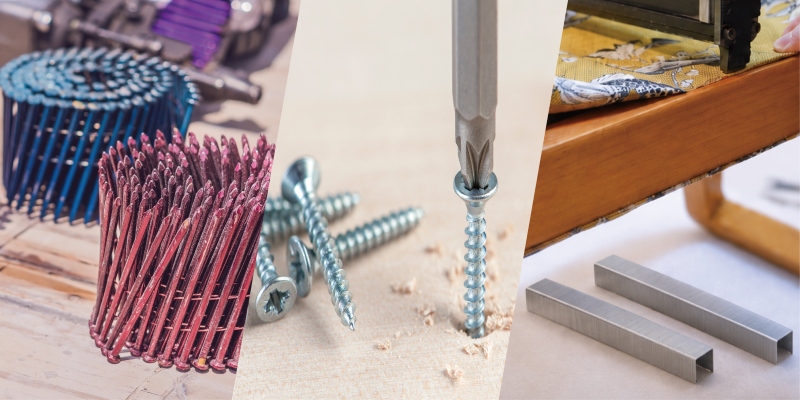
In modern manufacturing, product integrity hinges on the smallest details. Selecting the wrong fastener can lead to structural failure, costly downtime, and damage claims. For production engineers, it is a critical calculation of balancing speed, holding power, and material compatibility. This article explores the "Big Three" workhorses of high-velocity production—Industrial Nails, Screws, and Staples—helping you choose the ideal solution to maximize assembly line efficiency.
The Fastener Ecosystem
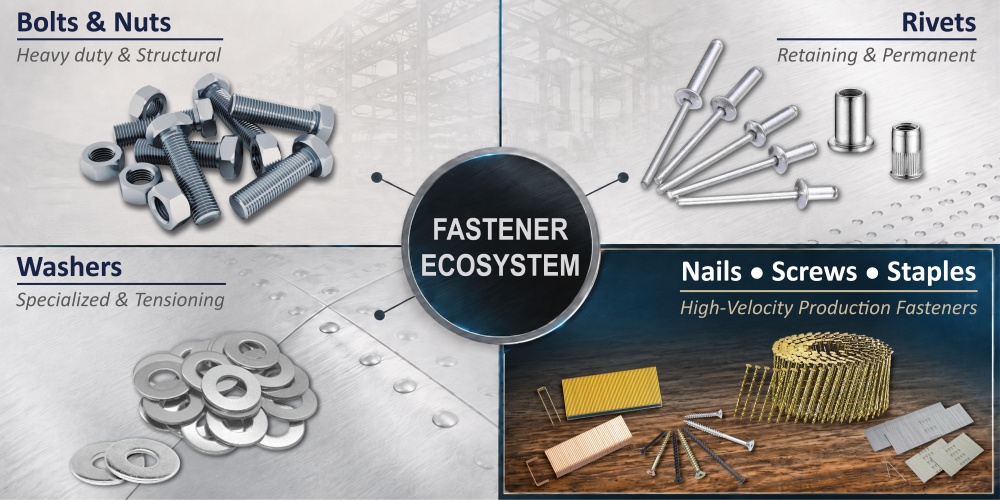
The industrial fasteners world is vast and highly specialized, functioning as a complete ecosystem where every component has a dedicated engineering purpose. To understand where your project fits, the entire fastener universe can be broadly categorized into four foundational quadrants based on their structural role and installation methods:
Heavy-Duty & Structural Fasteners
Designed for high-load capacity and solid engineering, this group heavily relies on structural bolts and mating nuts to clamp heavy steel components, as well as masonry anchors to secure fixtures directly into concrete or brick.
Retaining & Permanent Fasteners
Used when components must be permanently locked or precision-aligned. This category includes rivets—widely used in aerospace and sheet metal assembly—and alignment pins (like dowel or cotter pins) to keep moving parts in a fixed position.
Specialized & Tensioning Fasteners
Critical supporting components that optimize joint performance. This includes load-distributing washers that prevent pulling through, threaded studs for high-pressure piping, and specialized engineering clips or clamps.
High-Velocity Production Fasteners (The "Big Three")
The true workhorses of daily manufacturing, packaging, and woodworking. This vital category consists of Nails, Screws, and Staples.
While massive infrastructure and heavy machinery demand the extreme clamping of bolts or the permanence of rivets, most high-speed commercial assembly lines, pallet production, crating, and furniture manufacturing are entirely powered by the "Big Three": Nails, Screws, and Staples.
【Extended reading: All You Need to Know to Choose Your Perfect Air Nailers, Air Staple Guns, and Air Pliers】
Industrial Nails: Highest Shearing Strength and Installation Speed
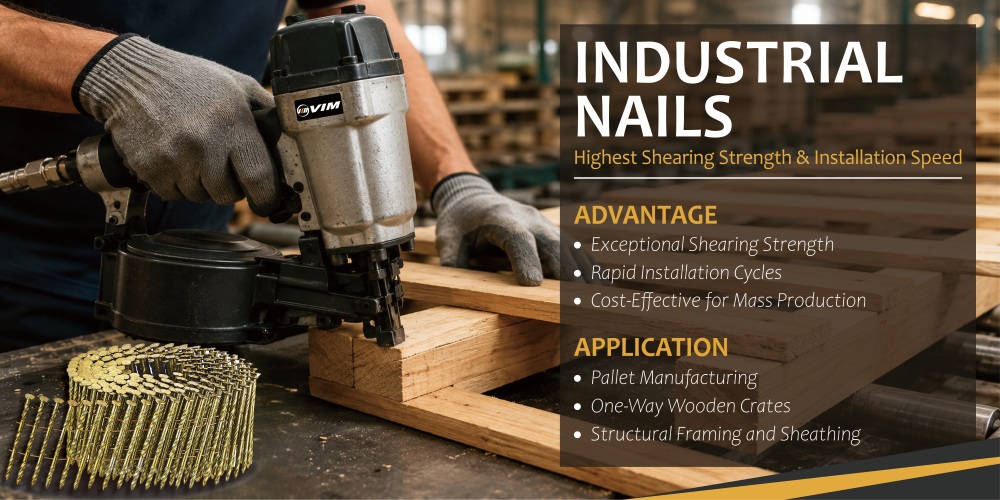
When high-volume production demands both velocity and structural flexibility, industrial nails are the go-to fastening solution. Driven efficiently by pneumatic nail guns, nails do not rely on threads; instead, they utilize the friction between their shank and the surrounding material fibers to create a tight hold.
Advantages of Nails
- Exceptional Shearing Strength
The primary engineering benefit of a nail is its ability to withstand lateral (side-to-side) shifting forces. Under heavy shearing stress, a quality steel nail will bend slightly rather than snap, making it incredibly resilient against the shifting loads encountered during transit. - Rapid Installation Cycles
Compared to threaded screws that require time-consuming driving and torque control, pneumatic nails offer near-instantaneous fastening. This rapid-fire capability significantly slashes assembly time per joint, drastically reducing labor costs and boosting high-volume production line output. - Cost-Effective for Mass Production
Per unit, nails are significantly more affordable than screws, making them the most economical choice for large-scale operations.
【Extended reading: 8 Expert Facts on Strip Nails for Smarter Fastening Choices】
Best Industrial Applications for Nails
Because of their high lateral strength and speed, industrial nails are the industry standard for:
- Pallet Manufacturing & One-Way Wooden Crates
Perfect for handling the intense dynamic vibrations and shifting loads during international shipping, allowing the wood structure to flex slightly without breaking apart. - Structural Framing and Sheathing
Ideal for building heavy wooden frameworks where materials are subjected to constant wind or structural movement.
【Extended reading: Stop Wasting Your Time! 9 Coil Nail Hacks for Faster Roofing & Crates】
【Extended reading: 5 Essential Checklist for Choosing Appropriate Flooring Nails】
Production Insight
Industrial nails are the undisputed standard for high-speed, cost-effective assembly of one-way shipping crates and pallets. However, they offer lower holding power against forces that pull the joints straight apart compared to screws.
【Extended reading: 5 Reasons Why VIM Concrete T Nails Deliver Unmatched Grip and Durability】
【Extended reading: Choosing the Right Coil Nails: 8 Essential Factors for Your Project】
Industrial Screws: Superior Holding Power and Structural Reliability
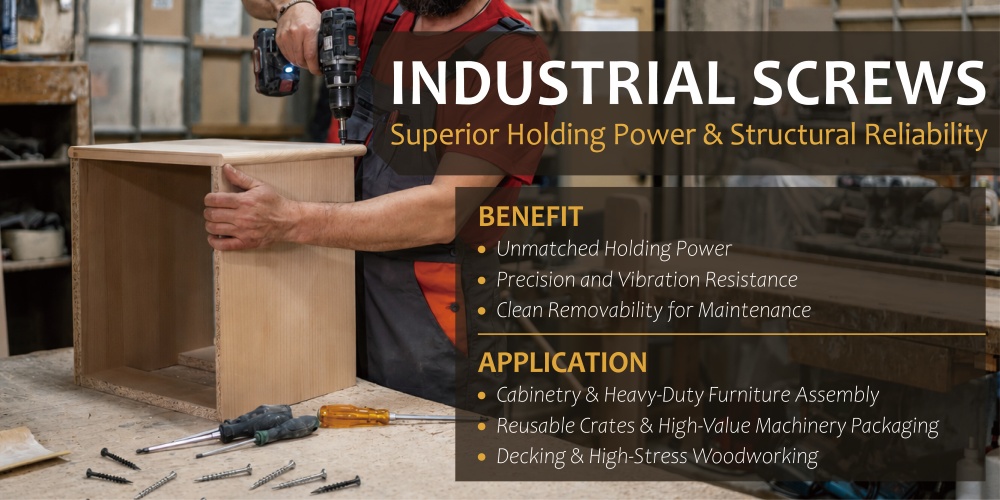
When a project demands maximum tensile strength—meaning the joint must resist being pulled straight apart under heavy loads—industrial screws are the definitive choice. Unlike nails, screws feature helical threads that cut deeply into material fibers, creating a mechanical wood-to-wood or metal-to-wood lock that tightly compresses the mating components.
Benefits of Screws
- Unmatched Holding Power
The standout feature of a screw is its high pull-out resistance. The threaded shank grips the internal walls of the material, ensuring the joint remains completely secure even under intense, constant tension. - Precision and Vibration Resistance
Because threads tightly clamp the materials together, screws prevent components from loosening over time, making them ideal for high-vibration environments. - Clean Removability for Maintenance
Screws allow for non-destructive disassembly. By reversing the torque with a power driver, the screw can be cleanly backed out, allowing parts to be serviced and reassembled without fracturing the structural panels.
Best Industrial Applications for Screws
Due to their premium clamping force and long-term reliability, industrial screws are widely deployed in:
- Cabinetry and Heavy-Duty Furniture Assembly
Ensuring joints remain flush and secure under structural weight and daily physical stress. - Reusable Crates & High-Value Machinery Packaging
Perfect for premium packaging where customers must easily open the panels via power tools without destroying the crate structure. - Decking and High-Stress Woodworking
Applied where environmental shifting or constant foot traffic would easily pop or loosen smooth-shank fasteners.
【Extended reading: Make Every Connection Count: 4 Clear Strategies to Choose the Best Fastener Materials】
Production Insight
While screws offer maximum grip, they require significantly higher torque and installation time compared to pneumatic nails. Additionally, the aggressive threading can cut wood fibers, creating wood shavings and debris or causing fine wood to split during high-speed insertion. To optimize your production line, it is highly recommended to pre-drill pilot holes or utilize premium self-tapping wood screws with specialized cutting flutes to clear debris automatically.
Industrial Staples: High-Velocity Fastening for Thin Materials
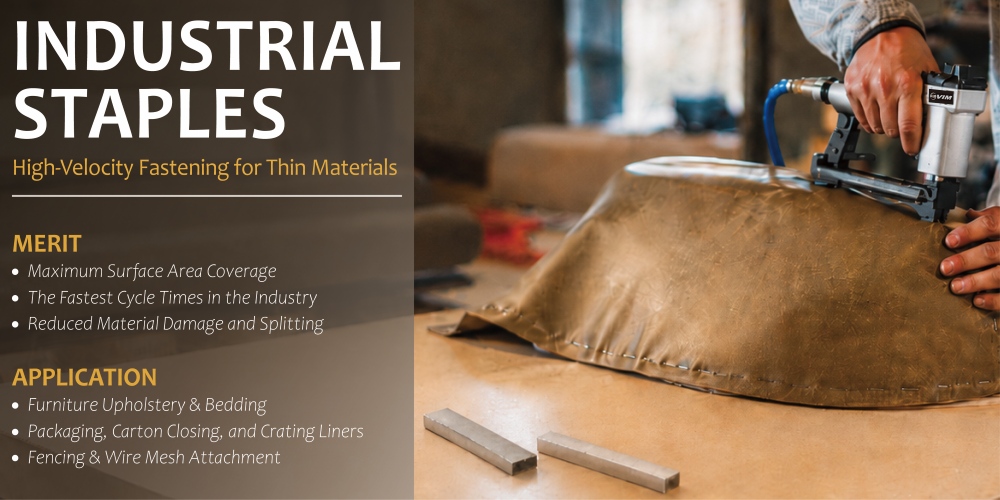
When production efficiency demands maximum output with minimum material damage, industrial staples are the definitive choice. Operating via high-speed pneumatic staplers, staples utilize a dual-leg design connected by a crown. This configuration allows them to distribute clamping force over a wider surface area, making them ideal for securing fragile sheets without tearing or splitting the substrate.
Merit of Staples
- Maximum Surface Area Coverage
The crown of a staple acts as a miniature bridge, firmly pressing down on the material's surface. This provides excellent holding power for thin sheet materials, fabrics, or wire mesh where a single nail or screw head might pull through. - The Fastest Cycle Times in the Industry
Because pneumatic staplers are lightweight and have minimal recoil, operators can achieve incredible speed on the assembly line. The anchoring process is near-instantaneous, making it the most productive method for repetitive, high-speed attachment tasks. - Reduced Material Damage and Splitting
Staples feature thinner wires compared to heavy nails or screws. They cleanly pierce through delicate woods and composites without cutting extensive fibers, minimizing the risk of splitting fragile workpieces.
【Extended reading: The Hidden Force in Every Staple: 9 Point Types That Make Fastening Last】
Best Industrial Applications for Staples
Due to their rapid-fire velocity and unique surface-clamping mechanics, industrial staples are widely deployed in:
- Furniture Upholstery and Bedding
Securely bonding fabrics, leathers, and padding directly to wooden frames. - Packaging, Carton Closing, and Crating Liners
Ideal for sealing corrugated boxes, attaching protective liners inside wooden shipping crates, or assembling lightweight plywood container panels. - Fencing and Wire Mesh Attachment
Rapidly securing wire grids to wooden posts or attaching thin backing panels to cabinetry.
【Extended reading: The 4 Hidden Powers of U Crown Mattress Staples in Every Spring】
Production Insight
Industrial staples are unmatched when it comes to speed and securing large surface areas of thin materials. However, because they lack the deep internal threads of a screw or the thick shank of a heavy nail, they are not designed to handle massive structural weight or heavy lateral shearing loads. If your factory is building the primary load-bearing frame of a building or a heavy pallet, stick to industrial nails. But for everything else running through a fast-paced packaging or upholstery line, staples will drastically lower your cycle times.
【Extended reading: The 4 Carton Staples Issues Ruining Your Packaging—Solved in Minutes】
Comparison Chart
| Feature | Nails | Screws | Staples |
|---|---|---|---|
| Core Strength | Best Lateral Strength (bends but won't snap under shifting loads) |
Best Holding Power (tightest grip, resists vibrations, and removable) |
Fastest Speed (great surface coverage, prevents splitting) |
| Main Flaw | Lower pull-out resistance (easier to pull straight apart). | Slowest installation; can split fine wood. | Cannot handle heavy structural weight. |
| Production Speed | Fast (pneumatic firing) |
Slow (requires torque & rotation) |
Extremely Fast (lightweight, minimal recoil) |
| Best Used For | ‧ Pallets ‧ One-way crates ‧ Structural framing |
‧ Cabinets ‧ Premium heavy furniture ‧ Reusable crates. |
‧ Upholstery ‧ Carton sealing ‧ Thin backing panels |
FAQ
Q1: Why are industrial nails the standard for pallet and shipping crate assembly?
A1: Industrial nails offer exceptional shearing strength, meaning they excel at withstanding lateral (side-to-side) shifting forces. Under transit stress, a quality steel nail will bend slightly rather than snap, keeping pallets and one-way wooden crates intact.
【Extended reading: A Deep Dive into Coil Nails: 5 Reasons You Should Choose Coil Nails】
Q2: When should a production line choose industrial screws over nails?
A2: Choose industrial screws when your project demands maximum tensile holding power against forces pulling joints straight apart. They are also ideal for high-vibration products or when you need non-destructive disassembly for future maintenance.
Q3: Can industrial staples replace nails in heavy structural framing?
A3: No. Industrial staples lack the thick shank of nails and the deep threading of screws. They are not engineered to handle massive structural weight. Always use heavy industrial nails for load-bearing frameworks or heavy pallets.
Q4: What is the primary mechanical advantage of industrial staples?
A4: Industrial staples feature a unique dual-leg design connected by a wide crown. This crown acts as a miniature bridge that distributes the clamping force over a broader surface area, preventing thin or fragile sheets from tearing.
Q5: Which production fasteners offer the fastest installation speed?
A5: Industrial staples offer the fastest cycle times in the industry. Because pneumatic staplers are lightweight with minimal recoil, operators can fire them with incredible speed, making them more productive for repetitive attachment tasks than nails or screws.
Conclusion
In conclusion, efficient manufacturing relies on matching the right mechanics to the right application. Industrial Nails remain the standard for mass pallets and one-way crates, utilizing high shearing strength to flex under transit vibrations without snapping. Industrial Screws deliver unmatched tensile holding power through helical threads that cut deeply into material fibers, preventing loosening in high-stress environments. Meanwhile, Industrial Staples excel in rapid attachment, using their unique crown design to distribute clamping force evenly across thin materials without causing splits. Optimum factory output is achieved only when engineers align these specific fastening strengths with their production goals.
Great engineering demands premium components. As your trusted industrial fastening partner, we provide high-grade nails, screws, and staples engineered to maximize your throughput and product durability. Whether you want to slash cycle times or reinforce heavy-duty packaging, our experts are ready to optimize your line. Contact our sales team today for free samples—let’s build something stronger together.
Get Started with VIM Today
Visit VIM's website or contact us directly to learn more about our offerings and how we can support your projects.
Article Classification
Recent Articles
- Nails, Screws, or Staples? Why Wrong Fasteners Might Ruin Your Project
- Stronger Hold, Less Tear-Through: The Power of Plastic Caps
- The 4 Hidden Powers of U Crown Mattress Staples in Every Spring
- 5 Essential Checklist for Choosing Appropriate Flooring Nails
- Every Corrugated Fastener You Want—All Here in One Comprehensive Guide